The creme brulee, the crown jewel of desserts, belongs to the family of baked custards and has a crackly caramelized crust of sugar torched by a torch’s flame. The custard is known as pot de creme when it is left unadorned. Before baking the custard, you should add a spoonful of freshly caramelized sugar to the baking dish so that it can be inverted and served as flan or crème caramel.
With the release of Iron Man on May 2, 2008, Marvel Studios debuted its first feature film and established one of the most lucrative film franchises in history. Thanks to the enormous box office success of Black Panther and Avengers: Infinity War, the Marvel Cinematic Universe is now stronger than ever, and it shows no signs of slowing down. But it all started with a B-list superhero that other studios weren’t convinced would work, a kid-focused focus group, an unexpected post-credits scene, and a recovering actor who went on to become the biggest movie star on the globe.
Here are 6 interesting facts regarding the making of Iron Man in honor of its tenth anniversary.
1. IT WAS IN DEVELOPMENT FOR YEARS.

Marvel Studios
Iron Man was really in development for many years at more than one studio before he made his debut, even though he was first in line when Marvel Studios started its now-famous mission to build a common universe of characters. Fox (which would later produce movies based on Marvel superheroes The X-Men and The Fantastic Four) optioned the character in the 1990s, and by 2000 it had been acquired by New Line Pictures.
There, it went around from writer to writer and the studio even had a director in mind (Nick Cassavetes, coming off his breakthrough with The Notebook in 2004). (Nick Cassavetes, fresh off his success with The Notebook in 2004).
Unfortunately, Bob Shaye, an executive at New Line, did not like the idea. He stated that the idea that a bulky steel suit could make a man fly was absurd and expressed doubt about the character’s box office appeal. Marvel executives let New Line’s option on the character expire in 2005 (something New Line was reportedly very upset about as they had planned to renew it), believing they could do a better job with the character when they launched their new studio plan. Marvel executives then started creating their own version of what would become Iron Man.
2. IT WAS THE FIRST MARVEL STUDIOS FILM BECAUSE OF KIDS.
Even more so than selling the films themselves, one of the primary reasons Marvel established its own film studio was to sell products based on its characters. Captain America was supposed to open the slate of movies, but by the time Marvel acquired the rights to Iron Man and Hulk (whose prior picture was produced at Universal Pictures), the crew had additional possibilities.
Toy sales based on Marvel characters were one of the primary reasons the company established its own film studio in the first place, even more so than the desire to promote the films themselves. Initially, it was intended for Captain America to open the slate of movies, but when Marvel acquired the rights to Iron Man and Hulk (whose prior picture was produced at Universal Pictures), the crew had more options.
3. TOM CRUISE WAS ONCE CONSIDERED FOR TONY STARK, BUT HE WASN’T THE ONLY ONE.
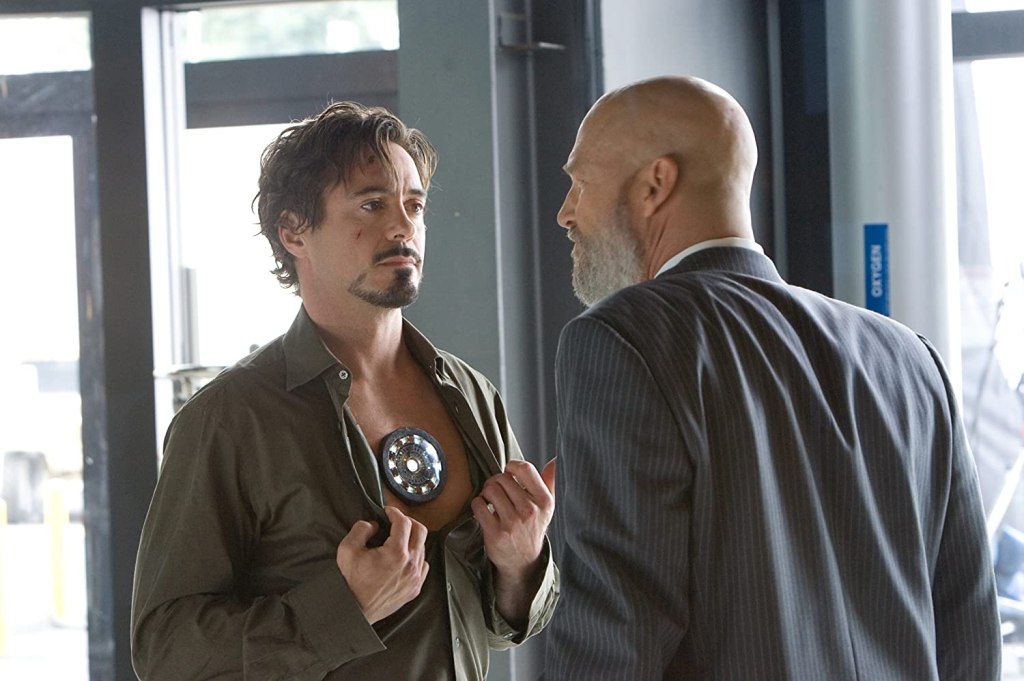
Several other celebrities competed for the part before Robert Downey Jr. wore the iconic armor of the Armored Avenger. Tom Cruise, who expressed interest in Tony Stark when the project was still at New Line, is the most well-known of these. Nicolas Cage, a lifelong comics enthusiast who nearly played Superman for Tim Burton in the 1990s, was another possibility from those pre-Marvel Studios days, but he too ultimately lost out.
When the character returned to Marvel, the studio gave Colin Farrell and Patrick Dempsey some consideration for the part, but producer Kevin Feige and director Jon Favreau thought Robert Downey Jr. was the best choice. Sam Rockwell, who eventually played fellow billionaire industrialist and Iron Man antagonist Justin Hammer in Iron Man 2, was Favreau’s backup plan in case Downey didn’t work out for the role (2010).
4. ROBERT DOWNEY JR. SHOWED UP FOR HIS SCREEN TEST WEARING A TUXEDO.
Before the release of Iron Man, Robert Downey Jr. was a renowned film and television actor whose career had significantly declined as a result of his very public battles with addiction. Due to his talent and the potential for his own issues to reflect those of Tony Stark, Feige and Favreau lobbied for Downey to be given the opportunity to play the role of Tony Stark (who, in the comics, is an alcoholic).
At the studio, Downey’s relatively cool career meant that he could be cast for what was effectively a discount compared to any of the megastars of the day. However, because of his addiction troubles, it might be challenging to get the Oscar nominee insured for the movie.
In order to get the part, Downey agreed to a screen test (something famous celebrities with decades of experience frequently get to skip in the casting process), and he arrived in typical Tony Stark fashion by donning a tuxedo. The Marvel execs were impressed by Downey, and they recruited him for $2.5 million with a potential bonus if the movie went well.
That sounds like a lot of money, but it pales in comparison to what Downey made when he renegotiated his deal with Marvel following the success of Iron Man (an estimated $50 million for just The Avengers).
5. DOWNEY WASN’T THE FIRST ACTOR TO JOIN THE CAST.
Iron Man and Marvel Studios were both unproven products at the time of its production, and the strategy within Marvel was to use the movies to make money on toys rather than rely on the movies themselves to create significant revenue.
This meant that Iron Man was produced on a relatively little budget for a movie of its scale and scope, which prompted certain crucial choices that would increase the movie’s visibility while keeping costs to a minimum. One of these choices was choosing Terrence Howard to play Col. James “Rhodey” Rhodes, Tony Stark’s best friend, as the project’s first actor.
Howard was in a good mood after receiving an Oscar nomination for his role in Hustle & Flow. Although he wasn’t yet a megastar, this brought him respect. Marvel could get another huge name on the movie’s poster and save a little money if they could use that prestige by casting Howard in a supporting part. Howard agreed to star in the movie for a $3.5 million pay, making him the highest-paid actor.
But he didn’t stay at Marvel for very long. He was replaced by Don Cheadle, who is still a co-star in the Marvel Cinematic Universe eight years after his debut after he asked for a raise in pay for Iron Man 2.
6. THE ORIGINAL INTENDED VILLAIN WAS THE MANDARIN.
The Mandarin, a scientist, and megalomaniac who wields 10 potent rings produced from alien technology was the first adversary the Marvel Comics studio thought Tony Stark may face in his debut adventure. When Marvel Studios unveiled its slate at San Diego Comic-Con in 2006, it appeared so apparent that the character would be the antagonist of the first movie that Favreau announced him as such. Later, Favreau explained this excitement as being a result of the studio’s discussions on its slate being more “generic” than specific.
By the time the cameras started rolling, Jeff Bridges’ character Obadiah Stane—a rival arms dealer who attempted to take over Stark Industries after Tony’s father Howard died in the comics—was the bad guy. The character was changed for the movie to represent Stark’s corporate steward while Tony was away, who ultimately attempted to take over the business from within as the comic book villain Iron Monger. The Mandarin eventually made an appearance in Iron Man 3 but was drastically altered from the comics.
7. MUCH OF THE MOVIE WAS IMPROVISED.
More than just a strong box office performance and the ability to produce sequel after sequel, Iron Man gave Marvel Studios a boost. Additionally, it established a certain tone of lightheartedness that has persisted throughout practically all of the company’s films, including the saddest ones. That’s thanks, in part, to the improvisation that took place on-site. Particularly Downey seemed to like incorporating humor into the heroic drama, and Favreau encouraged this.
Bridges claimed that this was partly because the Iron Man script was never finished when he looked back on the movie years later. Before the filming began, he, Downey, and Favreau would effectively hold impromptu rehearsals, which Bridges initially found problematic before changing his perspective on the picture.
Jon handled it very beautifully, Bridges remarked. “I was terrified. I was quite worried. I prefer to plan ahead. Man, my school requires me to memorize my lines. very organized That was extremely annoying, so I quickly adjusted. A lot of times in movies, something will brush on your fur and it won’t feel right, but that’s simply how it is.
You may waste a lot of time whining about it, or you can decide how you’re going to handle it and play the cards you’ve been dealt. What you can influence is how you see things and how you think about them. So I said, ‘Oh, what we’re doing here, we’re making a $200 million student film. We’re all just f*ckin’ around! We’re playin’. Oh, great!’ That took all the pressure off. ‘Oh, just jam, man, just play.’ And it turned out great!”


 Famous Movies